Beaver
Silent SpringBeaver are not incidental wildlife in Rachel Carson’s account of western sage country: by felling willows and building a dam, they help create a lake that supports large trout and a landscape valued for fishing and hunting. Their disappearance after indiscriminate spraying exposes how an intervention aimed at changing vegetation can unravel the habitat and relationships on which other species depend.
Place in the Sage Country
Carson situates Beaver in the high western plains and the lower mountain slopes, a land shaped over millions of years by the uplift of the Rocky Mountain system. Its severe climate and distinctive vegetation formed a habitat through long natural processes. Alongside the plants, animal life evolved in close adjustment to the land; the fleet pronghorn antelope and the sage grouse are among the creatures that embody that relationship. Beaver enter this larger ecological picture through the willows tracing the region’s streams, a second kind of vegetation with its own dependent community.
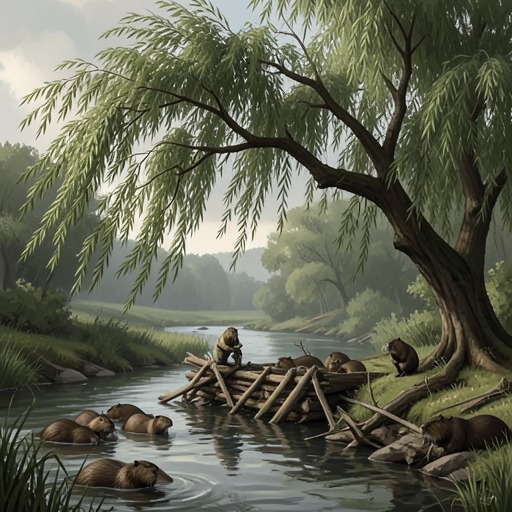
The willows were food for Beaver. The animals felled them to build a strong dam across a small stream, and their work caused water to back up into a lake. That constructed lake altered the conditions of the stream: trout that seldom grew beyond six inches in mountain creeks thrived there, and many became large. The beaver-made water and the surrounding willow thickets helped make the area attractive for recreation, with excellent fishing and hunting. Carson’s account thus gives Beaver a concrete ecological role: their feeding and building connect a plant community, a water habitat, fish, and human uses of the landscape.
The Spraying and Its Wider Target
The conflict begins with an effort to turn sage country into grassland. In the name of progress, land-management agencies responded to cattlemen’s demand for more grazing land, understood as grass without sage. Carson presents this aim as an attempt to improve on nature’s arrangements, not as a neutral change in vegetation. The land had developed as a system of plants and animals fitted to its conditions; converting it to a simplified pasture threatened relationships beyond the intended target.
Carson invokes William O. Douglas’s account of damage in Bridger National Forest in Wyoming. Under pressure to provide more grassland, the United States Forest Service sprayed about 10,000 acres of sage country. Sage was killed as intended, but the spray also killed the green ribbon of willows winding along the streams. The treatment was therefore not confined to the plant the authorities meant to remove: it struck the willows on which Beaver fed, along with the habitat that had supported the dam and lake. Carson identifies this collateral destruction as characteristic of a shotgun approach to nature, in which the reach of an intervention exceeds its stated purpose.
Disappearance and Ecological Unraveling
When Douglas visited the area in 1959, the year of the spraying, he saw shriveled, dying willows and was shocked by the scale of the damage. Carson’s account follows the consequences beyond that first visible injury. A year later, Douglas returned to find that Beaver were gone, as were the moose that had lived among the willow thickets. With the animals absent, their principal dam had gone out for want of attention from its skilled architects. The lake drained, and none of the large trout remained.
The remaining stream was a tiny creek, threading through bare, hot land without shade; the large trout could not live in it. The sequence makes Beaver’s role legible through what fails after their disappearance: the dam is no longer maintained, the lake ceases to exist, and the habitat that had supported large fish vanishes. This is not simply the loss of one species. The vegetation removed by the spraying had sustained Beaver, while the Beaver’s labor had helped sustain the lake and its fish. The damaged landscape records the linked consequences of eliminating both the willows and the animals that depended on them.
Narrative Significance
Carson uses the change at Bridger to challenge the idea that land can be improved by removing what managers label unwanted. The initial goal was more grass; the actual intervention killed sage and willows, and the effects extended to Beaver, moose, the dam, the lake, and trout. The contrast between a functioning, interconnected place and a bare, hot landscape gives the argument its force: damage spreads along relationships, so the intended target cannot be considered in isolation.
Beaver’s presence is conveyed through action and consequence rather than through an individualized animal story. They feed on willows, fell them, and build; once the willows are killed and the animals disappear, their dam is left unattended. Carson’s description of Beaver as skilled architects gives their work causal weight in the history of the place. The disappearance of Beaver marks a reversal in which a program designed to make the land more useful for grazing destroys the conditions that had made it rich in wildlife, fish, and recreation.